

































































Why Seahawks defense’s fourth-down stops were critical vs. 49ers | Four Downs
How big were the Seahawks' fourth-down stops vs. the 49ers? And what advice did Grey Zabel give Leonard Williams before his fourth-down sack?

The Seahawks have maintained all year they are just taking it one game at a time, even as they increasingly became considered as favorites to make it to the Super Bowl.
Now, they can truly say one game is all that’s needed to get there.
But after Saturday’s 41-6 thrashing of the 49ers in a Division-Round game to get to the NFC Conference Championship next Sunday at Lumen Field, the Seahawks insisted their process won’t change.
“One game at a time, man,” said defensive end DeMarcus Lawrence. “We know who we are, we know what we have in our locker room. Take it one play, one game at a time.”
They’ve followed that script to where now one game is all that stands between them and their ultimate goal.
Before moving on to the NFC title game, let’s review a few items from Saturday night in this week’s Four Downs with Seahawks beat reporter Bob Condotta.
Speaking of Four Downs, how big were fourth downs on Saturday?
If there was anything approaching a turning point it may have been San Francisco’s first series of the game when the 49ers drove to the Seattle 40 following Rashid Shaheed’s game-opening kickoff return for a touchdown.
A third-and-one Christian McCaffrey run went for no gain and the 49ers decided to go for it.
The play appeared to snap and Brock Purdy even threw a pass to Jauan Jennings for an apparent first down before all realized the play had been blown dead. Even the TV broadcast seemed momentarily confused before it was revealed the Seahawks had called timeout just as the ball was snapped.
The 49ers still decided to go for it but changed their play call, going with an option play with fullback Kyle Juszczyk and McCaffrey. The Seahawks weren’t confused and strung the play out and a desperate Juszczyk pitch officially went for a fumble and loss of 3 yards.
Seahawks coach Mike Macdonald said later he called timeout because he’d seen something, though he probably expectedly declined to elaborate on just what it was he’d seen.
49ers coach Kyle Shanahan, meanwhile, was visibly mad at the time that the Seahawks were given the timeout.
“I was upset with it,” Shanahan said. “We were able to run the play, but when it’s noisy, can’t totally fault them for that. I don’t know exactly how it happened. I didn’t know there was a timeout called. So I saw the play. So did they obviously. Sometimes when a coach calls a timeout you sometimes can’t get it to the main guy. So that’s what it is.”
Macdonald said he didn’t question that he’d gotten the timeout called in time.
Shanahan explained the fourth-down play call this way:
“We thought we could get to the edge because they’re all inside playing the gaps to take away the sneak. We thought we could leave one on the edge to option. We missed that and there was two on the edge, which made it a problem.”
Seattle took over and drove for a field goal and a 10-0 lead and then the 49ers fumbled on their next series and it was 17-0 just 13 minutes into the game. That was basically that.
But that wasn’t the end of San Francisco’s failed fourth downs, right?
No, it wasn’t.
The 49ers went for it on two other fourth downs in the second half: the first on the first series down 24-6, needing 2 yards from the Seattle 44, and the next late in the third quarter when it was 34-6, needing 3 yards from the San Francisco 38.
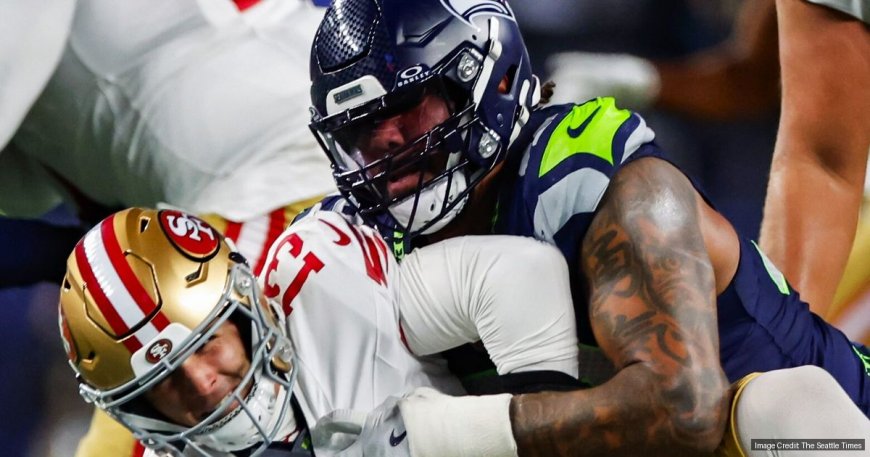
On the first, Leonard Williams broke through for a sack and 14-yard loss. On the next, Purdy was flushed out of the pocket and threw incomplete on a desperate pass.
Opponents went for it a lot on fourth down this year against Seattle — in fact, the Seahawks faced the most of any team in the NFL — often because opponents were behind, and often late in games. The Seahawks gave up a few in some games but have been good of late, allowing just five of 17 conversions the past seven games. Seattle has now allowed 23-of-48 for the season.
“They don’t count them as takeaways, but that’s really what they are,” Macdonald said. “We started the year kind of slow on fourth downs on defense. So to our coaches’ credit and our players’ credit, we identified it’s something we want to improve on. It kind of worked the problem, and the guys, they come to life on fourth down. It’s pretty cool.”
Whose advice did Leonard Williams use on his fourth-down sack?
On his sack, Williams simply steamrolled between right guard Dominick Puni and right tackle Colton McKivitz to chase down Purdy.
Williams later credited a maybe unlikely source for the play
“I’ve got to give a shoutout to the rookie, Grey Zabel, actually,” Williams said of Seattle’s starting left guard and first-round pick in the 2025 draft out of North Dakota State. “He’s a smart kid. Since camp, since OTAs, we’ve been going back and forth communicating. Giving each other tips on what works, what doesn’t work, and sometimes it’s good to get insight from a guy on the other side of the ball.
“He said to me at one point that he can tell I was getting a slide, the center sliding to me a lot. He was like, ‘Hey, why are you taking the inside move, when the slide is coming to you? You should just try to burn the B-gap.’ So that whole drive, I was taking off, trying to burn the B-gap, and it worked.”
The B-gap is the spot between the guard and tackle and going there instead of shading inside more means the center can’t logically come over and help.
A rookie’s sage advice paid off at a critical time.
The Seahawks really had the Niners’ number on third and fourth downs of late, didn’t they?
Yes.
The 49ers ended the regular season first in the NFL in third-down conversions at 49.8% (106-213). They also hit on 59.1% of fourth downs (13-22).
But in their past two games against the Seahawks — the final game of the regular season and Saturday — the 49ers were 8-for-21 on third downs, but 2-of-9 two weeks ago and 3-of-10 through the third quarter of Saturday’s game before converting some late in garbage time. They were 0-for-5 on fourth downs in the two games.
Said Purdy after Saturday’s game: “You really have to play smart football (against the Seahawks), check the ball down and stay on the field on third downs. And they’re a kind of defense, they’re not going to give up the big shot plays, or when you have one-on-one matchups and you capitalize, you get all the yards off of it. They’re going to play soft zone and make you go through your read and check it down, and a gain of 6, 7 yards, and really play that the whole game. And so they’ve done a good job with that. I think for all of us, including myself, we’ve got to understand that when we’re going against these guys — and that’s why it’s crucial to capitalize on third downs and stay on the field.”
Source: The Seattle Times
What's Your Reaction?
 Like
0
Like
0
 Dislike
0
Dislike
0
 Love
0
Love
0
 Funny
0
Funny
0
 Angry
0
Angry
0
 Sad
0
Sad
0
 Wow
0
Wow
0